Learning Outcomes
Upon successful completion of this lesson, students will be able to:
i. Define printers and plotters as devices that produce physical output from digital data.
ii. Differentiate between impact printers and non-impact printers, understanding their respective printing mechanisms.
iii. Identify and explain the characteristics of impact printers, such as dot matrix, drum, and chain printers.
iv. Recognize the working principles of non-impact printers, including inkjet and laser printers, and their advantages over impact printers.
v. Explain the role of plotters in producing large-format drawings and engineering plans, and their key features.
vi. Appreciate the diverse applications of printers and plotters in various fields, from personal use to professional environments.
Introduction
In the digital age, the ability to translate digital information into tangible form remains crucial for communication, documentation, and creative expression. Printers and plotters stand as the bridges between the digital and physical realms, converting electronic data into physical outputs that we can interact with and share. This lesson delves into the world of printers and plotters, guiding students through their diverse types, functionalities, and applications.
i. Impact Printers: Creating Images through Physical Contact
Impact printers, the pioneers of printing technology, produce images by directly striking ink onto paper. They utilize various mechanisms to achieve this, including:
Dot Matrix Printers: These printers employ a matrix of tiny pins that strike an inked ribbon, creating dots on paper to form characters and images.
Drum Printers: These printers rotate a drum covered with ink, transferring the ink onto paper as it passes over raised characters or images.
Chain Printers: These printers use a revolving chain with raised characters that strike an inked ribbon, transferring the ink onto paper.
ii. Non-Impact Printers: Achieving Precision without Contact
Non-impact printers, the predominant technology in modern printing, produce high-quality images without physically striking the paper. They rely on different techniques to deposit ink or toner onto the paper, including:
Inkjet Printers: These printers spray tiny droplets of ink onto paper, creating precise and detailed images.
Laser Printers: These printers utilize a laser to create an image on a drum, which then transfers toner particles onto paper, resulting in sharp and high-resolution prints.
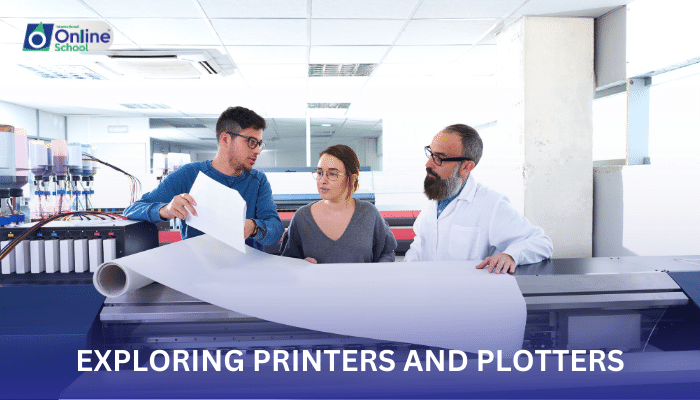
iii. Plotters: Masters of Large-Format Drawings
Plotters, specialized printers designed for large-format output, cater to the needs of engineers, architects, and designers who require precise and detailed drawings, maps, and technical diagrams. They typically employ ink pens or specialized plotters utilize cartridges filled with colored ink or dyes.
iv. Applications of Printers and Plotters: A Spectrum of Uses
Printers and plotters have become indispensable tools in various fields, including:
Personal Use: Home users rely on printers for everyday tasks, such as printing documents, photos, and creative projects.
Office Environments: Printers are essential for business operations, producing documents, reports, presentations, and marketing materials.
Professional Printing: Specialized printers are used in commercial printing services to produce high-quality brochures, magazines, and other printed materials.
Engineering and Design: Plotters are indispensable in engineering and design fields, producing large-scale drawings, maps, and architectural plans.
Printers and plotters serve as the vital link between the digital and physical worlds, enabling us to transform digital information into tangible forms that we can share, study, and appreciate. Understanding the principles of printing technology and the diverse capabilities of printers and plotters empowers individuals to harness their power for personal expression, professional communication, and creative endeavors in a wide range of fields. As technology continues to evolve, printing technology will undoubtedly advance, offering new and innovative ways to bridge the gap between the digital and physical realms.